
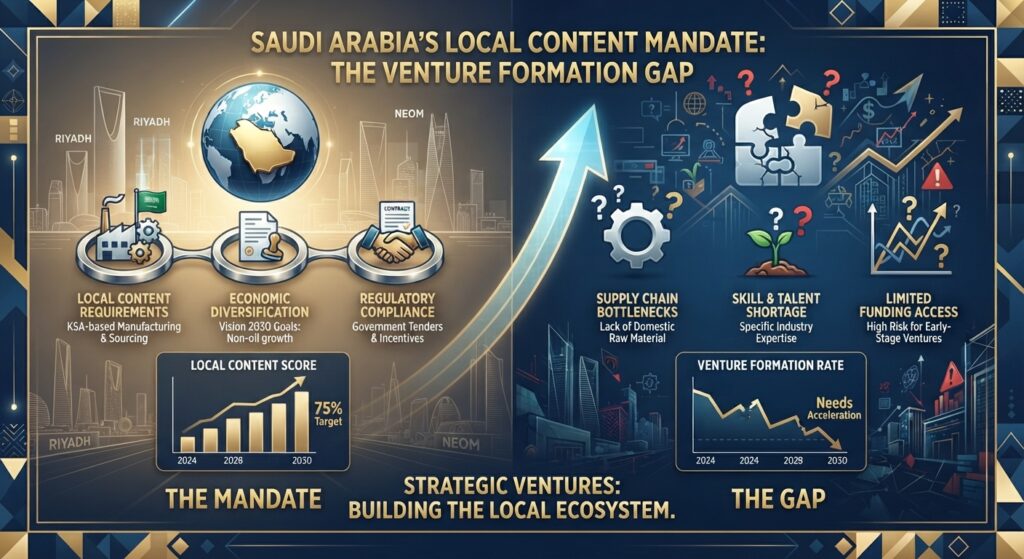
In February 2026, Aramco confirmed it had hit iktva’s founding target: 70 percent local content across its supply chain. The company set a new goal immediately — 75 percent by 2030. Read the headlines and this looks like a localization program moving smoothly into its next phase. Sit with the supplier base required to actually hit that number, and a different problem appears.
Local Content Is No Longer a Preference — It's a Scored Obligation
Since its founding, iktva has added an estimated $280 billion to Saudi Arabia’s GDP, attracted $9 billion in inward investment, and contributed to more than 200,000 direct and indirect jobs. The program has identified over 200 localization opportunities across 12 strategic sectors, representing roughly $28 billion in annual market opportunity.
That scale is no longer confined to Aramco’s own supply chain. In February 2026, the Local Content and Government Procurement Authority introduced minimum local-content percentages as a condition for benefiting from its Mandatory List of national products, starting with 233 products from August 2026 and extending to the rest of the list thereafter. The list itself has grown from 100 products at the authority’s founding to roughly 1,500 across 16 sectors, with the authority targeting 2,000 items and naming pharmaceuticals, food, and machinery as the focus of that expansion. Between iktva, GAMI’s military-industries localization mandate, and LCGPA’s government-wide procurement rules, Saudi Arabia is moving toward shared definitions of local content, though the three regimes still score separately and suppliers serving more than one report against each.
Where the Supplier Base Doesn't Exist Yet
The targets assume a supplier base that, in Saudi Arabia’s higher-value segments, is thin relative to the volumes procurement scoring now requires. Specialty materials. Automotive components. Pharmaceuticals and medical devices. Defense and aerospace-grade manufacturing. In these categories, the problem corporates face is not finding an existing local supplier and switching to them. It is that a qualified local supplier, at the scale procurement now requires, does not yet exist.
That is a formation problem, not a sourcing problem — and it changes what a corporate buyer or a CVC program should actually be building toward.
The Venture Opportunity: Formation, Not Sourcing
TURN8 treats the localization mandate as a venture-formation pipeline. Corporates already hold the contracted demand — the procurement commitments that iktva and LCGPA scoring now require them to meet. What they need is a mechanism to build the supplier companies against that committed demand, rather than waiting for the market to produce qualified vendors on its own timeline.
Where the domestic market cannot yet supply a capability, we import it — through partnership and through the TURN8 Accelerator — and use it to qualify and stand up new operating companies on a procurement clock, not an organic-growth clock. The engines involved: Venture Building to form the operating company, Corporate Venture Capital to structure the capital and governance, and the TURN8 Accelerator to import capability where none exists domestically yet.
What Could Go Wrong
A few honest caveats. Local-content scoring methodologies are still converging across iktva, GAMI, and LCGPA, and definitions could shift again before 2030. Large multinational suppliers may respond by building local joint-venture plants directly, rather than backing independent local suppliers — which changes the competitive landscape for any new venture entering these categories. Qualification timelines in regulated segments like defense and medical devices are long, and could outpace how quickly a new venture can be formed and certified. And upstream inputs — raw materials, precision components — often remain dependent on global supply chains that Saudi localization policy does not directly control.
For any corporate venture team evaluating this space, the question isn’t whether the local content percentage keeps climbing — the direction is set. It’s whether your thesis is built around sourcing from suppliers that already exist, or around forming the ones that procurement rules now require but the market hasn’t built yet.
Frequently Asked Questions
What is Aramco's iktva local content program?
In-Kingdom Total Value Add (iktva) is Aramco’s flagship localization program. It reached its founding target of 70 percent local content across Aramco’s supply chain in early 2026 and has since set a new target of 75 percent by 2030.
What is the Local Content and Government Procurement Authority (LCGPA)?
LCGPA is the Saudi government body that sets minimum local-content requirements for government procurement. In February 2026 it introduced minimum local-content percentages as a condition for benefiting from the list, beginning with 233 products from August 2026. The list currently holds roughly 1,500 products across 16 sectors, with the authority targeting 2,000.
Why is Saudi Arabia's localization mandate a venture opportunity, not just a compliance issue?
In several higher-value sectors — specialty materials, automotive components, pharmaceuticals, medical devices, defense, and aerospace — a qualified local supplier base does not yet exist at the scale procurement rules now require. That gap is a formation opportunity: building the supplier companies against already-committed corporate demand.
How is GAMI different from iktva and LCGPA?
GAMI (the General Authority for Military Industries) governs localization specifically within the defense and military industries sector, while iktva applies to Aramco’s own supply chain and LCGPA sets government-wide procurement rules. The three are moving toward shared definitions, but score independently, so suppliers serving more than one regime report against each.
What sectors are most affected by Saudi Arabia's expanded local content requirements?
The 2026 expansion of LCGPA’s mandatory list spans 16 sectors, with pharmaceuticals, food, and machinery specifically named among the priority categories, alongside iktva’s identified opportunities across 12 strategic sectors representing roughly $28 billion in annual market opportunity.
Learn More:

Partner, TURN8
Ahmed Hassan is a Partner at TURN8, the venture operating partner for GCC corporates and sovereign-linked institutions. With 10+ years of experience fundraising and operating in early-stage startups across the United States and MENA, Ahmed leads TURN8’s corporate venture programs across the GCC, designing and operating venture studios, accelerators, and CVC funds for national champions, family conglomerates, and multinationals.