
Real Estate Innovation Hub - Incubator Operations
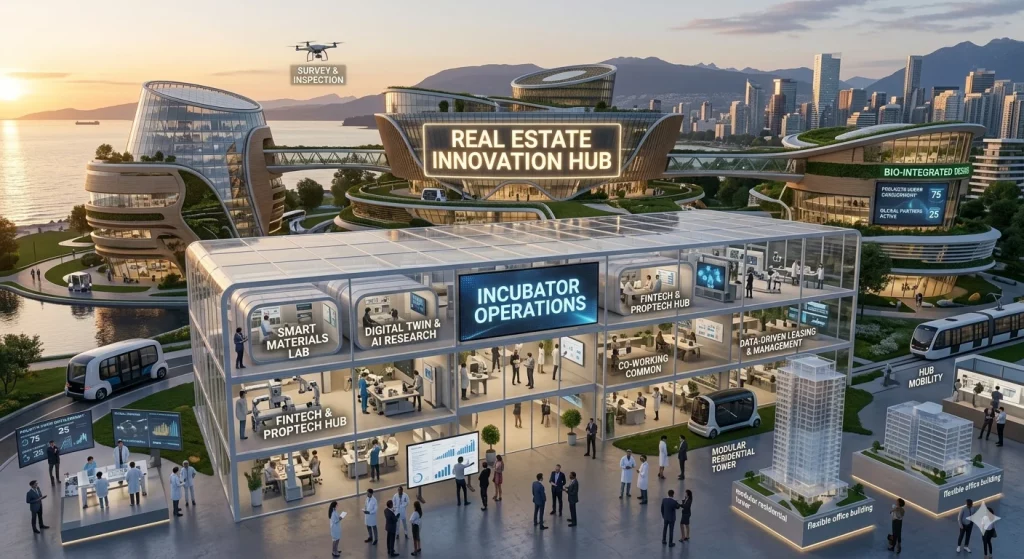
TURN8 designed and operated a PropTech incubator for a leading real estate developer, supporting early-stage startups from ideation to MVP while building a long-term innovation ecosystem around a smart city development.
Challenge
A leading regional real estate developer wanted to establish an innovation hub focused on property technology and smart city solutions to:
• Position the company as an innovation leader in the regional real estate sector.
• Source and develop technologies enhancing their real estate projects.
• Create a startup ecosystem around their flagship smart city development.
Key Constraints:
• Early-stage focus: Working with pre-MVP startups requiring patient capital and extensive support.
• Physical infrastructure: Needed to design and operate a physical co-working space within the development.
• Long timeline: Startups would need 18-24 months to reach commercial viability.
• Measurement challenge: How to quantify impact on developers’ broader business objectives?

TURN8’s Approach
Phase 1: Design and Build
• Designed an incubator program focused on real estate, construction tech, smart building, and urban mobility.
• Established partnership network, including mentors, service providers, and technical experts.
• Developed an 18-month curriculum covering ideation, validation, MVP, and commercialization.
Phase 2: Operations Launch
• More than 250 relevant early-stage startups and founders were identified through a systematic sourcing process.
• Hackathons and venture competitions generated 80 applications.
• Selected 15 teams for the inaugural cohort across construction tech, smart buildings, and urban solutions.
• Onboarded teams with access to workspace, technical resources, and developers’ pilot sites.
Phase 3: Ongoing Operations
• Provided hands-on support: business model development, technical prototyping, customer discovery.
• Facilitated access to the developer’s real estate portfolio for testing and pilots.
• Connected startups with investors for pre-seed and seed funding.
• Ran monthly workshops, mentor sessions, and progress reviews.
Outcomes
18-Month Program Results:
• 15 startups supported from ideation through MVP.
• 10 startups reached MVP and launched pilots, a 67% success rate.
• Six startups secured a total of $5M pre-seed or seed funding.
• Four pilot programs were executed within the developer’s portfolio properties.
• 12 of 15 startups are still operating post-launch, which is an 80% survival rate compared to 50% which is typical at this stage.
Strategic Impact for Developer:
• Innovation positioning: Recognized as a regional PropTech innovation hub.
• Technology pipeline: Four startups became potential commercial vendors.
• Ecosystem development: Ran over 200 events and workshops engaging the broader real estate community.
• Talent attraction: The innovation hub became a recruitment tool for developers’ teams.
• Vision alignment: Demonstrated commitment to diversification and the innovation economy.
Key Learnings:
• Early-stage support requires a longer timeline of 18-24 months compared to the accelerator model (3-6 months).
• Physical space is critical for early-stage teams that need collaboration and prototyping facilities.
• The developer’s real estate portfolio served as a testing ground for startups, making it a powerful value proposition.
• Patience required: Commercial outcomes emerge slowly, but survival rates are higher with comprehensive support.
• The dual objectives of startup success and corporate impact require careful balance and separate metrics.